
Şu 120/90-18 is an 18 inch rear size with a 120 mm section width, and it exists for a specific reason: it is the rear that stays fitted when the riding changes from motocross to enduro to rally. A 120/90-18 rear carries the load that compressed air would otherwise carry, so a thorn, a rock edge or a root cannot deflate it, and the tire around it is still inflated with air at the normal tire pressure — the mousse provides the structure, the air sets the profile, grip and rolling resistance.
Motobike Más builds the 120/90-18 Enduro Motorcycle Mousse Insert (SKU MMO-001) in its own Tianjin factory. It is the wide-profile rally and enduro rear, supplied in four density grades — 1.1bar, 0.8bar, 0.5bar and 0.3bar — so the same SKU covers high-speed rally racing, desert and gobi terrain, forest trails and extreme hard enduro. The published compound on this size carries a 120°C heat resistance rating and a 30% lower deformation rate during prolonged riding, which is what makes it a rally part rather than simply a large motocross insert.
This guide covers the specifications, the four density grades and what each is actually for, the terrain each grade suits, the machines the size fits, service life and how distributors order it.
Son güncelleme tarihi: 20 November 2026. Veri kaynakları: the published Motobike Más specifications for MMO-001 and the factory’s published fitment, density and lifespan tables. Unit weight for this SKU is published as available on request, and the factory confirms the current figure per order. Figures shown as “≈” are calculated from the published tyre size designations rather than measured by the factory.
A 120/90-18 is a 120 mm section width on a 90% aspect ratio, giving a 108 mm sidewall and an overall diameter of roughly 673 mm on an 18 inch rim. That combination — the width of a full-size rear on the smaller of the two rear rim diameters — is what separates this size from the rest of the range.
An 18 inch rim with a 108 mm sidewall gives a tire that is tall and wide at the same time. The extra diameter compared with a 19 inch rear buys ground clearance and suspension travel for a rock ledge, and the extra width buys traction on a surface that is loose rather than hard. This is the reasoning behind the size’s fitment: rally and enduro machines that have moved beyond motocross need both, and the tire that gives them both is an 18 inch rim carrying a full-size section width.
What the insert does not do is change the size of the tire. A 120/90-18 insert is cut for a 120 mm section width on a 90% aspect ratio on an 18 inch rim, and it will not seat correctly in a 110/90-19 or a 140/80-18 tire. The full size-by-size compatibility picture is on the mousse ek parçası boyut kılavuzu, and the fitting method is in the mousse ek parça kurulum kılavuzu.
Read off the sidewall, 120/90-18 means a 120 mm section width, a 90% aspect ratio and an 18 inch rim diameter. The section width is how much rubber the tire puts on the ground; the aspect ratio is how tall the sidewall is as a percentage of that width. On this size the two numbers give a 108 mm sidewall — the tallest sidewall of any published size except the 140/80-18 — and an overall diameter of roughly 673 mm.
That diameter is worth checking against the front of the same machine. A 90/90-21 front works out at roughly 695 mm and an 80/100-21 front at roughly 693 mm, so a rally or enduro bike on this rear runs a front about 20–22 mm taller in overall diameter than its rear. That is a wider front-to-rear gap than a full-size motocross bike carries, and it is a direct consequence of the 18 inch rear — the same geometry that gives the bike its clearance over a rock ledge.
| Veri noktası | Değer | Durum |
|---|---|---|
| Boyut belirtimi | 120/90-18 — 120 mm section, 90% aspect ratio, 18 in rim | Yayınlandı |
| SKU | MMO-001 | Yayınlandı |
| Yoğunluk sınıfları | 1.1bar / 0.8bar / 0.5bar / 0.3bar | Yayınlandı |
| Birim ağırlık | Available on request | Available on request |
| Heat resistance rating | Up to 120°C | Yayınlandı |
| Heat resistance improvement | 25% | Yayınlandı |
| Impact absorption improvement | 18% | Yayınlandı |
| Deformation rate during prolonged riding | 30% lower | Yayınlandı |
| Malzeme | High elasticity foam compound | Yayınlandı |
| Dönen kütlenin azaltılması | Bir tüp ve bir ağır hizmet tipi jant kilidine karşı 40%'ye kadar | Yayınlandı |
| Kullanım ömrü | 200–500 racing miles typical | Yayınlandı |
| Menşe ülke | Tianjin, Çin | Yayınlandı |
| Parti boyut toleransı | Üretim partisi başına | Talep üzerine teyit edilir |
| Current grade naming and terrain guidance | SKU başına | Talep üzerine teyit edilir |
| Boyut | Bölüm genişliği | En-boy oranı | Yanak yüksekliği | Jant çapı | Toplam çap |
|---|---|---|---|---|---|
| 120/90-18 — this size | 120 mm | 90% | ≈ 108 mm | 18 inç | ≈ 673 mm |
| 140/80-18 — heavy-duty rear | 140 mm | 80% | ≈ 112 mm | 18 inç | ≈ 681 mm |
| 110/90-19 — standard MX rear | 110 mm | 90% | ≈ 99 mm | 19 inç | ≈ 681 mm |
| 100/90-19 — narrow MX rear | 100 mm | 90% | 90% | 19 inç | ≈ 663 mm |
| 90/90-21 — typical front | 90 mm | 90% | ≈ 81 mm | 21 in | ≈ 695 mm |
| 80/100-21 — MX front | 80 mm | 100% | ≈ 80 mm | 21 in | ≈ 693 mm |
“≈” değerleri, yayınlanmış boyut tanımlarından hesaplanır — yanak yüksekliği, kesit genişliğinin en-boy oranıyla çarpımıdır; toplam çap ise jant çapı artı yanak yüksekliğinin iki katıdır. Bu değerler, boyutları birbirleriyle karşılaştırmak için kullanışlıdır ve fabrika tarafından ölçülmüş rakamlar değildir; fabrika, talep üzerine ölçülen boyutları teyit eder. Yayınlanmış her boyut için tam çap tablosu mousse ek parçası boyut kılavuzu.
Four density grades are published for the 120/90-18: 1.1bar (Hard), 0.8bar (Medium Soft), 0.5bar (Soft) and 0.3bar (Ultra Soft). The grade is a measure of how hard the foam itself is, not the pressure you put in the tire; how the bar figure relates to an equivalent tire pressure is explained in full on the mousse ek parçası boyut kılavuzu.
| Yoğunluk derecesi | Feel | Yayınlanmış arazi kılavuzu |
|---|---|---|
| 1.1bar | Sert | High-speed rally and racing |
| 0.8bar | Orta Yumuşak | Desert, grassland, gobi terrain |
| 0.5bar | Yumuşak | Forest trails and technical riding |
| 0.3bar | Ultra Yumuşak | Extreme hard enduro and rock terrain |
What is distinctive about this size is that the four grades are not simply a choice of ride — they correspond to four genuinely different kinds of riding, and the published terrain guidance on this product maps onto the four competition formats the size is used in:
That mapping is what makes the range commercially useful rather than merely broad. A distributor stocking one SKU can serve a rally team, an enduro rider, a trail rider and a hard enduro competitor from the same product, and the grade choice is what separates them. The published service life varies accordingly, and the table below breaks that down by operating condition.
A rally or enduro insert does not usually fail from a puncture or from being cut. It fails from heat, and that is why the published compound on this size is specified differently from the rest of the range.
The published specification for the 120/90-18 gives a heat resistance rating of up to 120°C, alongside a 25% improvement in heat resistance and a 30% lower deformation rate during prolonged riding. Those three numbers are connected, and the mechanism is worth understanding because it changes how the insert should be used.
Heat comes from the rear, and it comes from the engine. The rear wheel carries drive torque for the whole of the run, and the heat generated in the carcass is converted energy from the same torque that moves the bike forward. A bike doing 150 km/h on gravel is generating more heat in its rear tire than a motocross bike doing 30 seconds of full throttle, because the heat is proportional to time under load rather than to peak load.
Prolonged heat causes compression set, and compression set is what fails. Foam that is held compressed at temperature for hours does not recover fully when the pressure comes off. The insert gets a permanent flat spot, and the tire around it starts to sit differently. The published improvement in recovery performance after prolonged riding is what keeps this size usable across a multi-stage rally rather than only across a single stage.
Which is why the grade choice is a heat decision as much as a terrain decision. A hard grade resists heat but transmits impacts, and a soft grade absorbs impacts but softens under heat. The published guidance puts 0.8bar on desert, grassland and gobi terrain — the longest, hottest, most sustained use on this size — precisely because the compound on this product holds its shape better under heat than the same compound in a firmer or softer setting would.
For an importer this matters commercially, because the heat case is the one where a tube fails most visibly. A tube that loses air on a hot gravel stage is a stage the rider ends. The hard enduro versus desert racing comparison sets out the terrain side of that, and the published lifespan guide covers the temperature and hours-based figures across the range.
| Published application | What it asks of the insert |
|---|---|
| Rally racing | Sustained high-speed load and heat |
| Desert riding | Long hours at temperature in open terrain |
| Yüksek hızlı çakıl sürüşü | Constant load at speed on a hard surface |
| Long-distance enduro stages | Hours of rough terrain at distance |
| Extreme hard enduro competitions | Repeated severe impacts over rock |
Where this size sits among the published rear range is worth stating alongside the applications, because the five rear sizes the factory publishes are not interchangeable stock — each is cut for one tire and one rim diameter:
| Boyut | SKU | Position | Typical use | Published unit weight |
|---|---|---|---|---|
| 110/90-19 | MMO-003 | Rear | Standard full-size motocross and enduro rear; the wide-profile rear | 1.2–1.5 kg |
| 100/90-19 | MMO-004 | Rear | Narrower full-size rear for lighter riders and quicker steering | 1.1–1.4 kg |
| 120/90-18 | MMO-001 | Rear | Rally, hard enduro and desert rear on an 18 inch rim | Available on request |
| 140/80-18 | MMO-002 | Rear | Heavy-duty adventure, rally and expedition rear | Available on request |
| 90/100-16 | MMO-009 | Rear | Youth motocross, mini dirt bike and pit bike rear on a 16 inch rim | 0.7–0.9 kg |
The published application list for this size is worth reading as a set rather than individually, because it covers the formats that sit between motocross and expedition racing:
What that list means for a distributor is that this size has the widest application spread of anything the factory publishes. The same SKU covers a bike that spends a weekend in the desert and a bike that spends it in the rocks, and the only variable that changes is which of the four grades is fitted.
For sizing and fitment, the mousse selection guide for enduro riding covers how the 120/90-18 relates to the other rear sizes for a specific terrain, and the 140/80-18 heavy duty rear covers the size that takes over when the machine and its load go up another step.
Service life on this size is driven by density, heat and terrain rather than by distance alone, which is why the published figures are quoted in hours. A rally stage covers distance quickly, and a trail day covers it slowly, so two riders on the same insert can see very different lives from it.
| Durum | Effect on mousse life |
|---|---|
| Optimal internal temperature 40–85°C | Normal operating window, full performance |
| Above 100°C internal temperature | Foam begins to soften and lose structural integrity — the fastest way to end a mousse |
| Hard density on rally stages | Replace roughly every 1,000–1,500 km |
| Sealed and stored at 25–35°C | 2–3 years before slight hardening |
| Stored unsealed or in direct sunlight | 6–12 months; oxidation and surface cracking begin |
The published figures for closed-cell mousse on this size fall between roughly 25 hours in extreme hard enduro and 200 hours for hard-density rally use — a range that reflects the density choice far more than the riding does. The softest grade is the one that wears through quickly, and the hardest is the one that survives a rally season, and the difference between them is a multiple rather than a percentage.
Actual life on the 120/90-18 depends on three things: the grade fitted, the heat the rear is put through, and whether the insert is being used for one long rally or a season of enduro stages. The general replacement and storage criteria that apply across every size are covered in mousse insert lifespan ve how long a motorcycle mousse lasts.
Köpük dolgu parçası üzerinde asla petrol bazlı yağlayıcılar kullanmayın. Petrol ürünleri nitril kauçuğu bozar ve bozulmuş bir iç lastik, tasarruf değil, bir risk oluşturur. Hem lastik karkasının iç kısmında hem de iç lastiğin kendisinde yalnızca su bazlı köpük yağlayıcı kullanın.
Genel işlem sırası — lastik kenarının yerleştirilmesi için hazırlık, yağlayıcı sürülmesi, ilk kenar, ikinci kenar, son yerleştirme ve profili sabitleyen basınç döngüsü — şu belgede belirtilmiştir: mousse ek parça kurulum kılavuzu ve bu boyuta da aynen uygulanır.
One point is worth making specifically about this size. The 18 inch rim is the smaller of the two rear rim diameters in the range, and the tire that goes on it carries a 108 mm sidewall — so there is a long length of rubber to fold into a comparatively short rim. That combination is where a twisted insert shows up: an insert that went in unevenly will not sit true in the carcass, and the tire will not seat evenly on the bead either. On a size that spends its life on rally and enduro terrain, that is not a cosmetic issue, because the bike is being asked to absorb rock edges continuously.
Check the bead seat is clean and the insert is sitting square before the tire goes on, and inspect the insert at every refit rather than assuming that a tire which was fine at the start of the stage is still fine at the finish.
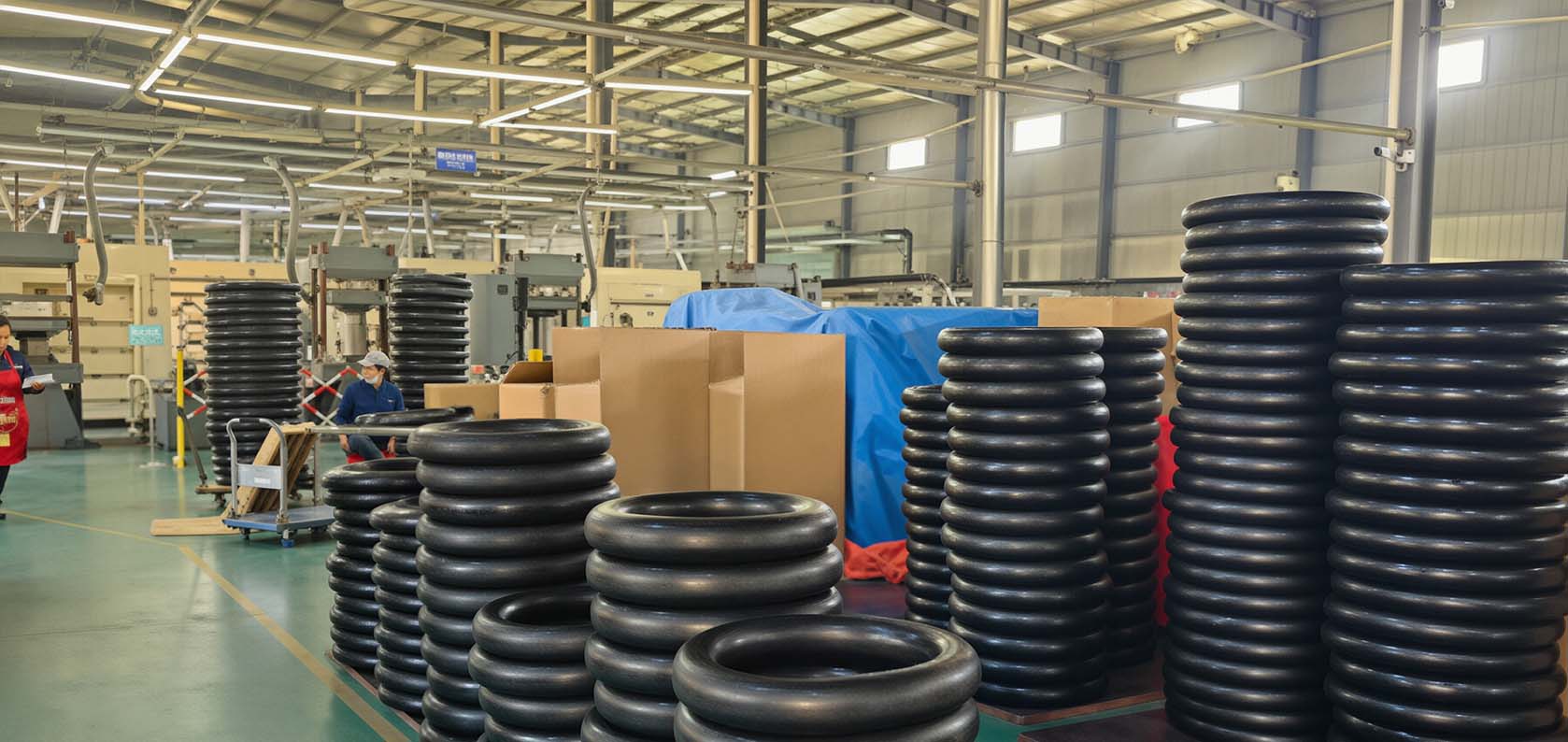
Motobike Más, Nankai İlçesi’ndeki kendi Tianjin tesisinde, 50.000 m²’lik üretim alanı, depo ve Ar-Ge alanını kapsayan bir alanda mousse üretmektedir. Bu fabrikanın tam turu ürün yelpazesinin ardında yer alan üretim hatlarını, depolama sistemini ve kalite sistemlerini göstermektedir.
Three of the published properties of this size are manufacturing outcomes rather than design intentions, and they are the three that matter to a rally buyer: the 25% improvement in heat resistance, the 18% improvement in impact absorption and the 30% lower deformation rate during prolonged riding. Each one is produced by the foam compound and the density distribution, and each one is verified before an insert leaves the factory.
The inspection regime on this size is density testing, compression recovery testing, heat resistance testing, dimensional inspection and structural integrity verification. Compression recovery is the check that speaks directly to the rally case, because it is the property that determines whether an insert returns to shape after a long stage at temperature. The full process is described in the kalite kontrol süreci adım adım kılavuzu.
The 120/90-18 is supplied as a made-to-order factory line rather than from finished-goods stock. The terms that apply across the range — the minimum set per order and confirmed on request, standard OEM production at 15–30 days depending on quantity and customization, pre-production samples for evaluation, and shipping by sea on FOB Tianjin terms, by air freight or DDP — are published together on the mousse ek parçası boyut kılavuzu, o toptan alım rehberi ve OEM ve ODM üretimi sayfalar.
For an importer or distributor, this size is the one where the density mix matters more than the unit count. All four grades come out of the same line and the same tooling, so a customer who takes all four is taking one product with four specifications rather than four products — and a rally or enduro customer almost always needs more than one, because a hard enduro rider and a rally team want different things from the same tire size.
Private-label production on this SKU includes custom branding, packaging and colours, and the published custom hardness development route is worth raising with a customer who needs a grade that is not exactly one of the four — a rally team with a specific heat problem is a common case for it. The size also pairs with the 140/80-18 heavy duty rear for expedition work, and the two run on the same line with the same tooling.
A 120/90-18 mousse insert is a closed-cell foam tube made to fit a 120/90-18 off-road motorcycle tire. It replaces the inner tube, carries the load that compressed air would normally carry, and cannot be deflated by a puncture. The tire is still inflated with air at normal tire pressure — the mousse provides the structure, the air sets the profile and grip. It is a 120 mm section width on a 90% aspect ratio, giving a 108 mm sidewall and an overall diameter of roughly 673 mm on an 18 inch rim, which is what makes it the wide rear that sits on the smaller of the two rear rim diameters.
Four grades are published for this size and each maps onto a different kind of riding. 1.1bar (Hard) is for high-speed rally and racing, where the foam is carrying a mostly downward and mostly constant load. 0.8bar (Medium Soft) is for desert, grassland and gobi terrain, which is the longest and hottest use on this size. 0.5bar (Soft) is for forest trails and technical riding, where the tire needs to conform rather than hold a line. 0.3bar (Ultra Soft) is for extreme hard enduro and rock terrain, and wears fastest of the four. A distributor can therefore serve a rally team, an enduro rider, a trail rider and a hard enduro competitor from one SKU.
No, and this is the most misunderstood specification in the whole mousse category. The bar figure is a density-equivalent rating that describes how hard the foam itself is. It is not the pressure you put in the tire. The tire is still inflated with air at the bike’s normal off-road pressure, the mousse carries the structural load, and the air sets the profile and the contact patch. Reading 1.1bar as 11 psi and inflating the tire to it is how a buyer ends up with a tire that is far too hard for the terrain and a ride that is far too harsh.
Published figures for closed-cell mousse on this size fall between roughly 25 hours in extreme hard enduro and 200 hours for hard-density rally use. Service life here is driven by density, heat and terrain rather than by distance alone, which is why the figures are quoted in hours — a rally stage covers distance quickly and a trail day covers it slowly, so two riders on the same insert can see very different lives from it. The published life varies with the grade fitted, with the softest grade wearing through fastest.
A serviceable insert can be transferred to a new tire of the same size, so a tire that shreds on a rock ledge does not also mean a new insert. What ends an insert’s life is usually compression set rather than a puncture, and on this size in particular heat is the main driver — the published compound carries a 120 degree Celsius heat resistance rating and a 30% lower deformation rate during prolonged riding for exactly that reason. Inspect a used insert for a permanent flat spot rather than simply refitting it.
Cool, dry, out of direct sunlight, never compressed or folded, and kept away from ozone sources such as electric motors and welding equipment. A batch held in a hot warehouse or shipped in a hot container loses shelf life quickly, which matters on this size in particular because heat is what degrades it. Stock rotation is worth raising with a distributor who is holding the four density grades for a rally season rather than selling them through in a season.
The minimum for the 120/90-18 is set per order and confirmed by the factory on request, because the range is made to order rather than pulled from finished-goods stock. Standard OEM production typically runs 15 to 30 days depending on quantity and customization, pre-production samples are available for evaluation before a bulk order, and shipping is by sea on FOB Tianjin terms, by air freight or DDP. Because all four density grades come out of one line with the same tooling, taking more than one grade is taking one product with four specifications rather than four products.
Motobike Mas manufactures tires and mousse inserts under ISO 9001:2015 quality management, to DOT and ECE production standards. Every insert also passes density testing, compression recovery testing, heat resistance testing, dimensional inspection and structural integrity verification before packing. On this size the compression recovery check carries particular weight, because it is the property that determines whether an insert returns to shape after a long stage at temperature. The certification documentation is on the motorcycle tire certifications page and the inspection regime in the quality control walkthrough.
Yes. Private-label production on this SKU includes custom branding, packaging and colours, and the factory publishes a custom hardness development route. That second option is worth raising with a rally team that has a specific heat or impact problem, because the four published grades are a general framework rather than a fixed list. A distributor combining the 120/90-18 with the 140/80-18 for expedition work can combine both sizes on one purchase order, since they run on the same production line with the same tooling.
The 120/90-18 Enduro Motorcycle Mousse Insert (SKU MMO-001) is produced on the Motobike Más line in Tianjin and supplied to importers, distributors, dealers, race teams and aftermarket brands worldwide. It is available in 1.1bar, 0.8bar, 0.5bar and 0.3bar densities, with a published heat resistance rating of up to 120°C and a 30% lower deformation rate during prolonged riding. Unit weight for this SKU is published as available on request.
Ask for the current minimum, the density mix and the lead time on the 120/90-18, or take a set of pre-production samples before placing a bulk order. Because all four grades come from one line, a customer taking more than one of them is taking one product with four specifications rather than four products — and private-label production with custom branding, packaging and colours is available on this SKU, along with custom hardness development for accounts with a specific heat or impact requirement.
Şu 120/90-18 product page tam teknik özellikleri içerir ve fabrikanın iletişim sayfası takes specification requests directly. Importers building a rear range should read the mousse ek parçası boyut kılavuzu for the full size and grade comparison, the hard enduro versus desert racing comparison for the terrain logic behind the grade choice, and the ISO 9001, DOT ve ECE sertifikasyon belgeleri for the file a distributor needs.
90/90-21 Mousse Insert: Off-Road Enduro and MX Front Fitment Guide - Motobike Más şöyle diyor:
[…] two SKUs. The 110/90-19 motocross mousse insert guide covers the rear half of that pair, and the 120/90-18 enduro mousse insert and 140/80-18 heavy duty mousse insert cover the rally and adventure rear […]
110/90-19 Mousse Insert | Motocross & Enduro Fitment Guide şöyle diyor:
[…] the two closest comparisons, the dedicated guides cover the detail: the 120/90-18 enduro and rally mousse insert for the larger enduro and desert rear, and the 140/80-18 heavy duty mousse insert for adventure and […]